The ₹12 Lakh Problem You Didn’t Know You Had
Let’s talk numbers. Contractors in India and the GCC often lose ₹12 lakh or more annually due to billing gaps. It’s not just unbilled work—it’s billing disputes, manual errors, and inflexible invoicing methods that don’t align with contract terms. The result? Revenue leakage that quietly eats away at your margins.
You might be thinking, "We already track billing in spreadsheets or basic accounting tools." But here’s the problem: those tools don’t connect the dots. They don’t enforce measurement-to-invoice chains or alert you when something’s missing. That’s where enterprise software, specifically designed for contractors, steps in.
What Are Enterprise Software Solutions?
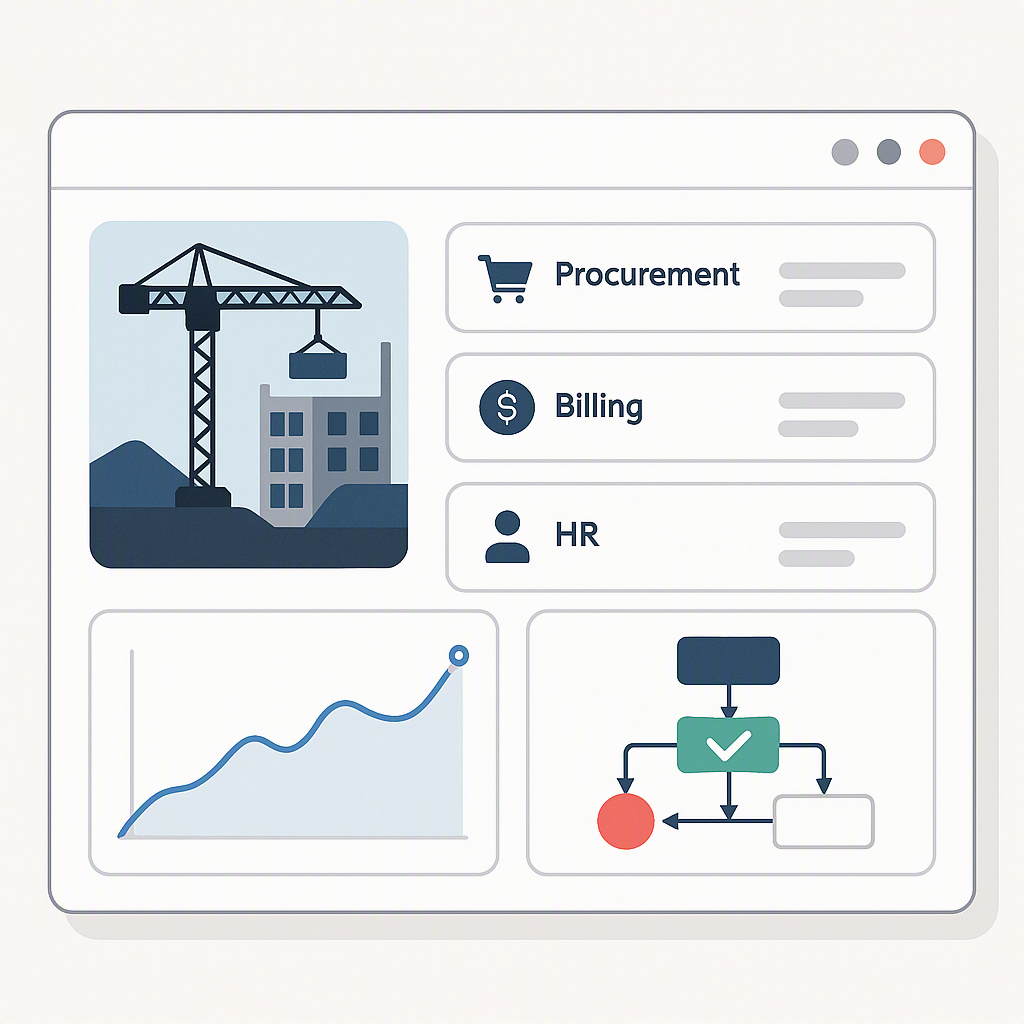
At their core, enterprise software solutions are systems designed to unify business processes under one roof. Think of them as the control center for your operations—handling everything from procurement to payroll, and yes, billing too. Unlike generic tools, they’re built to handle the complexity of industries like construction, where every project has unique scopes, BOQs (Bills of Quantities), and billing terms.
Take JobNext, for example. It’s an ERP (Enterprise Resource Planning) software that replaces 6-8 disconnected tools with one unified platform. But the real magic? Its six billing methods, designed to handle every contract scenario.
Concrete Example: How JobNext Works
Let’s say you’re managing a ₹5 crore construction project. The BOQ includes 500 line items, each with its own measurement terms and payment milestones. Without a unified system, you’re relying on spreadsheets, emails, and possibly a small accounting tool to keep track. Mistakes are inevitable—an omitted line item here, a duplicate invoice there—and suddenly, ₹12 lakh disappears from your margins.
With JobNext, every completed task links directly to the BOQ, and invoices are generated based on actual certified measurements. If a subcontractor finishes 80% of their scope, the system prompts you to update the measurement book. No update? No invoice. This ensures every rupee earned is accounted for, reducing disputes and delays.
How Billing Gaps Happen
Billing gaps aren’t always obvious. They creep into your operations through these common scenarios:
- Unbilled Work: Imagine a subcontractor completes 80% of their scope, but no one updates the measurement book. That’s revenue sitting unpaid.
- Over-Billing Disputes: When you bill more than what’s certified, clients push back. The back-and-forth delays payments and strains relationships.
- Recurring Contracts: Monthly service contracts often rely on manual calculations. Miss one line item, and you’re underbilling.
- Multiple Invoices Across Projects: For clients with multiple ongoing projects, fragmented invoices create confusion—and payment delays.
Case Study: A Facilities Management Firm
A facilities management company in the GCC was losing over ₹25 lakh annually due to recurring contract billing errors. Their team manually calculated monthly charges for 12 sites, often missing additional services like emergency repairs. After switching to JobNext, the automated billing module flagged missed items and consolidated all site invoices into a single document per client. The result? Revenue leakage dropped by 90%, and payments were received 15 days earlier on average.
How Enterprise Software Fixes It
Enterprise software like JobNext solves these problems by enforcing structure and automation. Here’s how:
- Measurement-to-Invoice Chains: Every completed scope is measured, certified, and invoiced in a structured workflow. No measurements? No invoice.
- Locked BOQs: The BOQ stays auditable. Unauthorized changes? Not happening.
- Automated Billing for Recurring Contracts: The system generates monthly invoices based on pre-set measurements. No manual input, no missed items.
- Consolidated Invoices: Handling multiple projects for one client? Combine them into a single invoice for clarity.
Actionable Steps for Contractors
- Audit Your Current Billing Process: Identify gaps such as missed line items, manual errors, or delayed invoices.
- Calculate Revenue Leakage: Use past data to estimate how much you’re losing annually.
- Implement an Enterprise Software Trial: Most platforms, including JobNext, offer demos or free trials. Test features like automated billing and BOQ locking.
- Train Your Team: Ensure everyone understands the workflow changes. Enterprise software is only as good as your team’s adoption.
Why This Matters for Contractors
Margins in construction are razor-thin—any leakage hits hard. Accurate billing ensures you’re not just breaking even but actually profiting. And let’s be honest, chasing unpaid invoices isn’t how you want to spend your time.
But there’s another benefit: trust. When clients see clear, accurate invoices backed by auditable data, disputes drop. Payments speed up. Relationships improve. That’s the kind of win-win every contractor needs.
Example: Trust in Action
A mid-sized construction firm implemented JobNext after facing repeated disputes with one of their largest clients. With auditable BOQs and consolidated invoices, disputes dropped by 70%. The client even recommended the firm to others, citing their "professional and error-free invoicing." Trust pays dividends.
Decision Framework: Should You Invest in Enterprise Software?
| Question | Yes | No |
|---|---|---|
| Are you losing more than ₹10 lakh annually? | Enterprise software can recover lost revenue and prevent future leakage. | Stick with manual processes if losses are minimal. |
| Do you manage multiple projects? | Consolidated invoicing and BOQ tracking streamline operations. | Single-project firms may not need advanced tools. |
| Are billing disputes frequent? | Auditable workflows reduce disputes and speed up payments. | If disputes are rare, this may be lower priority. |
| Is your team tech-savvy? | Adoption will be easier, and ROI faster. | Training may be required, but it’s worth the effort. |
The Obvious Objection
You might argue, "We’ve been fine with manual processes so far." But have you really? If you’re losing ₹12 lakh a year to billing gaps, that’s hardly "fine." Enterprise software isn’t just about fixing what’s broken; it’s about building a system that doesn’t break in the first place.
Conclusion: Stop Losing Money
If billing gaps are bleeding your margins, it’s time to act. Tools like JobNext don’t just track invoices—they ensure every rupee you’ve earned is invoiced and accounted for. Get started with JobNext →
Learn more at JobNext.ai - Construction ERP