The Hidden Cost of Disconnected Systems
If you’re a contractor running multiple projects, you’ve felt the pain of juggling disconnected systems. One software for tendering, another for procurement, Excel files for billing, and yet another tool for payroll. Sound familiar? The result is chaos — missed approvals, duplicate entries, revenue leakage, and margin erosion.
Let’s break this down with specific examples, actionable insights, and real-world case studies to understand why disconnected systems are more than just an inconvenience — they’re a direct threat to your profitability.
The Problem: Disconnected Systems Create Chaos
Take procurement, for example. Without a unified platform, material requisitions (MRs) are sent via email, vendor quotes are tracked manually, and purchase orders (POs) often get issued without proper approval chains. This kind of workflow isn’t just inefficient; it’s dangerous. A single unchecked PO can blow your project budget.
Real-World Example: Procurement Gone Wrong
Consider a mid-sized contractor managing 20 projects across multiple regions. Without a centralized system, material requisitions are scattered across WhatsApp, emails, and handwritten notes. One over-enthusiastic site manager orders 50 tons of steel instead of 35, due to a miscommunication. The excess material sits idle at the site, tying up capital and escalating storage costs. Meanwhile, critical supplies for another project are delayed because procurement doesn’t have visibility into inventory across sites.
This is not an isolated incident. According to a 2021 study by McKinsey, construction companies lose up to 20% of their potential project value due to inefficiencies in processes like procurement, supply chain management, and billing.
The Solution: Unified Systems
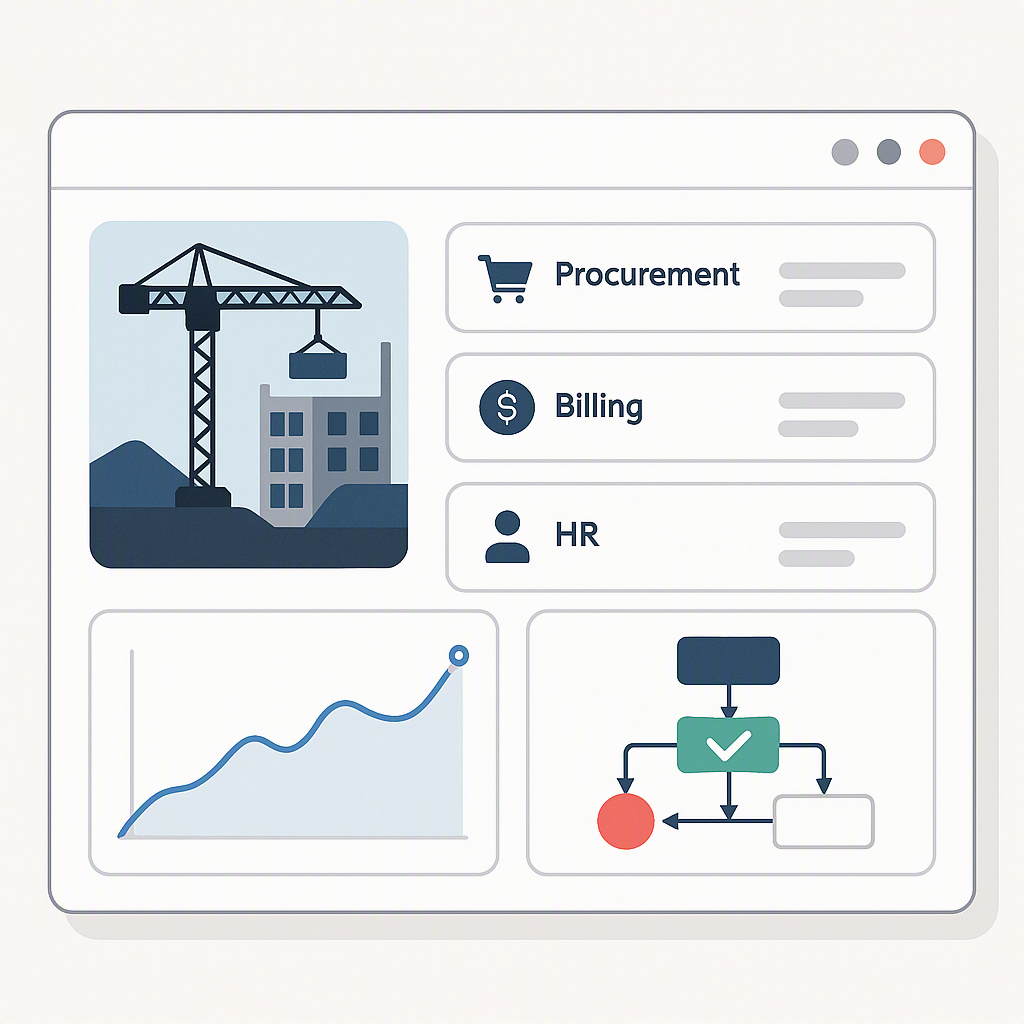
Enterprise software solutions exist to fix this mess. Platforms like JobNext replace fragmented tools with a single system that integrates tendering, procurement, billing, HR, and finance. Instead of chasing data across spreadsheets and emails, everything flows through structured workflows.
A Practical Example: Procurement Without Chaos
Let’s visualize how procurement works in a unified ERP system like JobNext:
- Material Requisition (MR): Site teams submit structured MRs directly into the system. These are tagged to specific projects and budgets.
- Request for Quotation (RFQ): The system automatically generates RFQs and sends them to pre-approved vendors.
- Vendor Offers: Vendor quotes are uploaded into the system, where they are automatically compiled into a standardized comparison sheet.
- Purchase Order (PO): Approved quotations are converted into POs, which are validated against the project budget and sent for final approval.
Every step is tracked, and the system enforces approval workflows. Contractors using JobNext report slashing their procurement cycle time by 40% and reducing material over-ordering by up to 15%. Source: Primary Site Blog.
Unified Systems = Real-Time Profitability
Disconnected systems don’t just waste time — they blind you to your margins. Imagine trying to calculate profitability across projects when your billing system doesn’t talk to your finance system. Or when subcontractor payments aren’t tied to completed work measurements. How do you even know if your project is on budget?
Actionable Insight: The Power of Real-Time Data
With a unified platform like JobNext:
- Cost Tracking: Real-time dashboards show cost vs. budget tracking at every level — from individual BOQ items to overall project scope.
- Alerts: Automated alerts flag margin erosion or budget overruns before they spiral out of control.
- Simplified Subcontractor Management: Payments are tied to completed work, ensuring accuracy and reducing disputes.
Data-Driven Decision-Making
According to a report by Deloitte, firms that adopt real-time data tracking see a 5-10% improvement in project margins. Unified systems make this possible by providing actionable insights, not just raw data.
Real-World Impact: Case Studies
Case Study 1: Granite Construction’s $32M Alaska Highway Project
Granite Construction faced a major challenge in controlling costs for their $32M highway project. Disconnected systems made it nearly impossible to track margins in real time. By implementing JobNext, they gained visibility into cost escalations across BOQs and subcontractor payments. Early intervention on over-budget items saved them over $400K in potential losses. Source: JobNext’s Case Study.
Case Study 2: Small Contractor Saves 18% on Procurement
A small contractor managing just five projects switched to JobNext after losing Rs. 25 lakh in a year due to procurement inefficiencies. Within six months, they reported an 18% reduction in procurement costs and a 25% improvement in project timelines.
Why Contractors Must Act Now
If you’re still running disconnected systems, you’re losing money — period. The construction industry is brutal when it comes to margins. Small mistakes compound into massive losses. Enterprise software isn’t just a nice-to-have; it’s a lifeline.
Decision Framework: Is Unified Software Right for You?
| Question | If Yes, Consider Unified Software |
|---|---|
| Do you manage 3+ projects at once? | Visibility across projects is critical. |
| Are procurement delays common? | Centralized workflows prevent bottlenecks. |
| Are your margins razor-thin? | Real-time tracking flags erosion early. |
| Do you use 3+ tools for operations? | Consolidation reduces errors and saves time. |
If you’re dealing with margin erosion or disconnected systems, JobNext can help. Get started today →
Learn more at JobNext.ai - Construction ERP