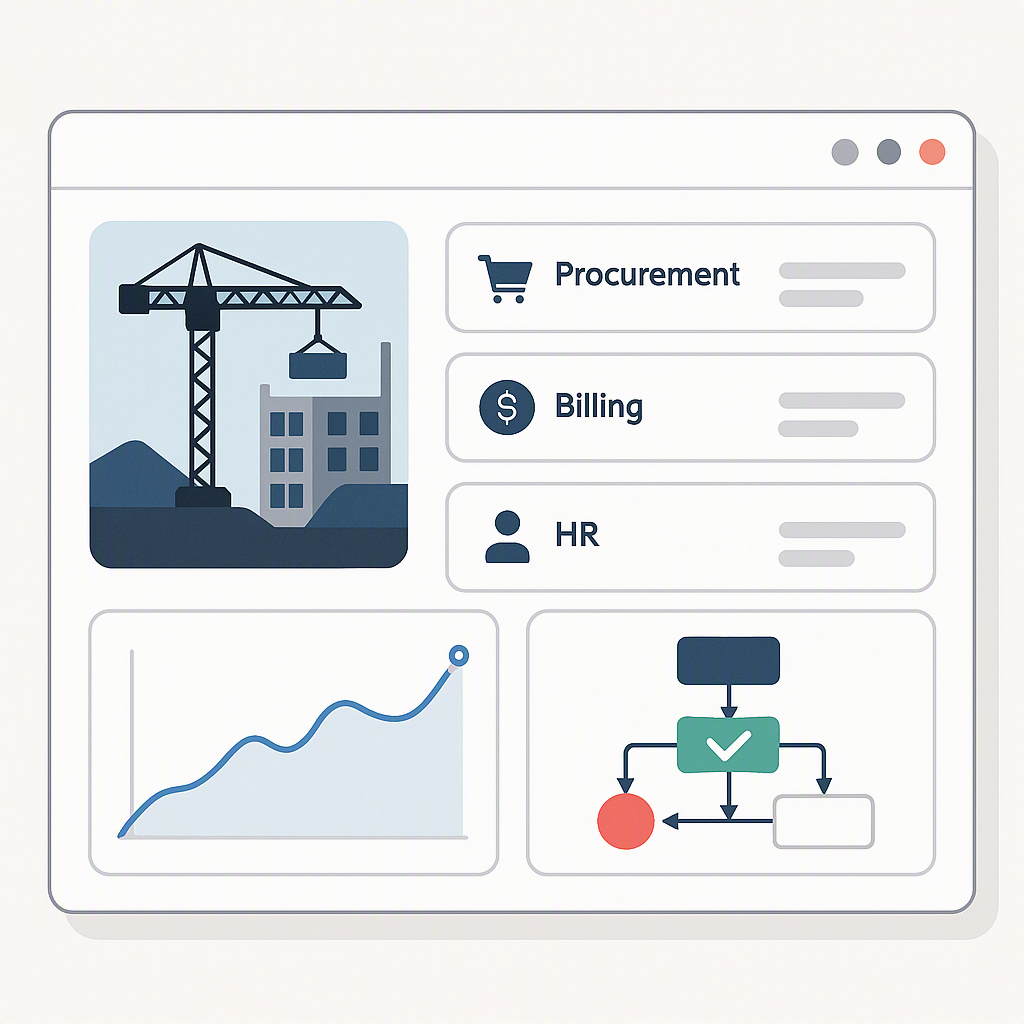
Procurement Chaos: The Silent Margin Killer
Every contractor I’ve met has a procurement story. The tender was won, the project kicked off, and then everything fell apart because material didn’t show up on time or came at twice the expected cost. Sound familiar?
Procurement is one of the biggest sources of margin erosion in construction. A small contractor handling ₹50 crore in projects annually can lose ₹25 lakh or more just from procurement delays, over-ordering, or inflated vendor quotes. And it’s not just the direct cost—delays mean penalties, unhappy clients, and stressed project teams.
But the solution is within reach.
Why Procurement Chaos Happens
To fix the problem, you need to understand the root cause. Procurement chaos stems from two major issues: disconnected systems and manual processes. Let’s break these down.
Disconnected Systems
Most contractors juggle a mix of software and manual tools:
- Excel sheets for inventory tracking
- WhatsApp for vendor communication
- Standalone accounting tools like Tally for payments
None of these systems talk to each other. For example, your site manager might update inventory in Excel, but your procurement officer has no visibility into those numbers when placing orders. This results in over-ordering or delays.
Manual Chaos
Material requisitions (MRs) often sit in email inboxes, waiting for approvals. Vendor quotes come in mismatched formats, making it impossible to compare apples-to-apples. Purchase orders (POs) are issued without checks and balances, leading to rogue purchases and inflated costs. It’s a recipe for disaster.
Real-World Example: Manual Chaos in Action
A contractor in Mumbai lost ₹10 lakh on a single project because they accidentally double-ordered 300 tons of cement. The site team sent an MR via WhatsApp, while the procurement team issued a PO based on older inventory data in Excel. By the time the mistake was caught, the vendor refused to cancel the shipment, citing lack of proper documentation. The extra cement sat unused, eating into margins.
SaaS Platforms Bring Order to the Chaos
The solution isn’t hiring a bigger team or creating more complex spreadsheets. It’s structure. SaaS platforms like JobNext streamline procurement workflows and eliminate errors.
Key Features of SaaS Procurement Platforms
-
Structured Workflows:
- Every procurement starts with a Material Requisition (MR). From there, it flows into RFQs sent to vendors, vendor quotes compared side-by-side, and finally POs issued with approval chains.
- No step is skipped. No email gets lost.
-
Budget Validation:
- JobNext enforces budget discipline. Every MR is checked against approved project budgets before moving forward.
- If a site team requests materials outside the approved budget, the system flags it instantly.
-
Vendor Accountability:
- Vendor offers are logged and compared in the system.
- If a vendor tries to overcharge, you’ve got proof to push back.
-
Real-Time Inventory Management:
- Platforms like JobNext integrate inventory tracking directly into procurement workflows.
- When a PO is issued, the system updates inventory automatically, ensuring no double-orders.
Concrete Example: ₹12 Lakh Saved
One of JobNext’s clients—a mid-size contractor in Delhi—used to lose ₹12 lakh annually to procurement delays. Their biggest problem? Vendor RFQs were sent late, leading to rushed purchases at higher costs.
After adopting JobNext, the structured MR → RFQ → PO workflow ensured RFQs were sent out weeks earlier. This gave their procurement team time to negotiate better rates with vendors. The end result? They cut costs by ₹12 lakh in the first year.
Why Most Contractors Haven’t Fixed This Yet
You might be thinking, "Okay, sounds great, but we’ve managed fine with Excel and WhatsApp so far." Sure, until you scale.
Scaling Exposes Weaknesses
Managing ₹5 crore in projects is very different from managing ₹50 crore. When you’re running 10+ concurrent projects, manual processes break down:
- Bottlenecks in approvals delay procurement.
- Disconnected systems lead to errors in inventory and vendor quotes.
- Lack of visibility results in costly penalties due to project delays.
Common Objections to SaaS Platforms
-
“SaaS is too expensive.”
- Let’s break that myth. JobNext’s subscription cost is a fraction of what you’re already losing to procurement inefficiencies.
-
“It’s too complicated to switch.”
- Platforms like JobNext integrate with tools you already use, like Tally, so you don’t need to ditch existing systems. Implementation can be phased, starting with procurement workflows.
-
“My team will resist the change.”
- Start small. Fix one process—like procurement—and show them the results. Once they see the time and cost savings, scaling to other modules becomes easier.
Decision Framework: Should You Adopt SaaS for Procurement?
| Factor | Excel/Manual Processes | SaaS Platform (e.g., JobNext) |
|---|---|---|
| Cost of Errors | High (₹5–25 lakh/year) | Minimal |
| Scalability | Poor | Excellent |
| Team Collaboration | Disconnected | Unified |
| Implementation Time | Immediate but chaotic | 4–6 weeks, structured |
| Vendor Accountability | Low | High |
Call to Action: Stop the Bleeding
If you’re losing lakhs to procurement chaos, it’s time to act. SaaS platforms like JobNext can bring structure, transparency, and savings to your business. Get started free →
Learn more at JobNext.ai - Construction ERP