What Are Enterprise Software Solutions and How They Transform Businesses
If you’re a contractor running multiple projects, you’ve likely felt the pain of juggling disconnected systems. Tendering happens in spreadsheets, procurement in email chains, billing in standalone software—and HR? That’s another headache entirely. This fragmented workflow doesn’t just create inefficiencies; it actively eats away at your margins.
Imagine a project manager tracking material purchases for an HVAC job. They approve a PO for materials but don’t realize the vendor’s offer has expired. Why? Because the procurement system doesn’t communicate with the billing system. By the time the error is caught, the project is already running over budget.
This is not a rare scenario. Many contractors face cost overruns due to poor tracking and disconnected systems, as highlighted in industry reports like those from McKinsey.
How Enterprise Software Changes the Game
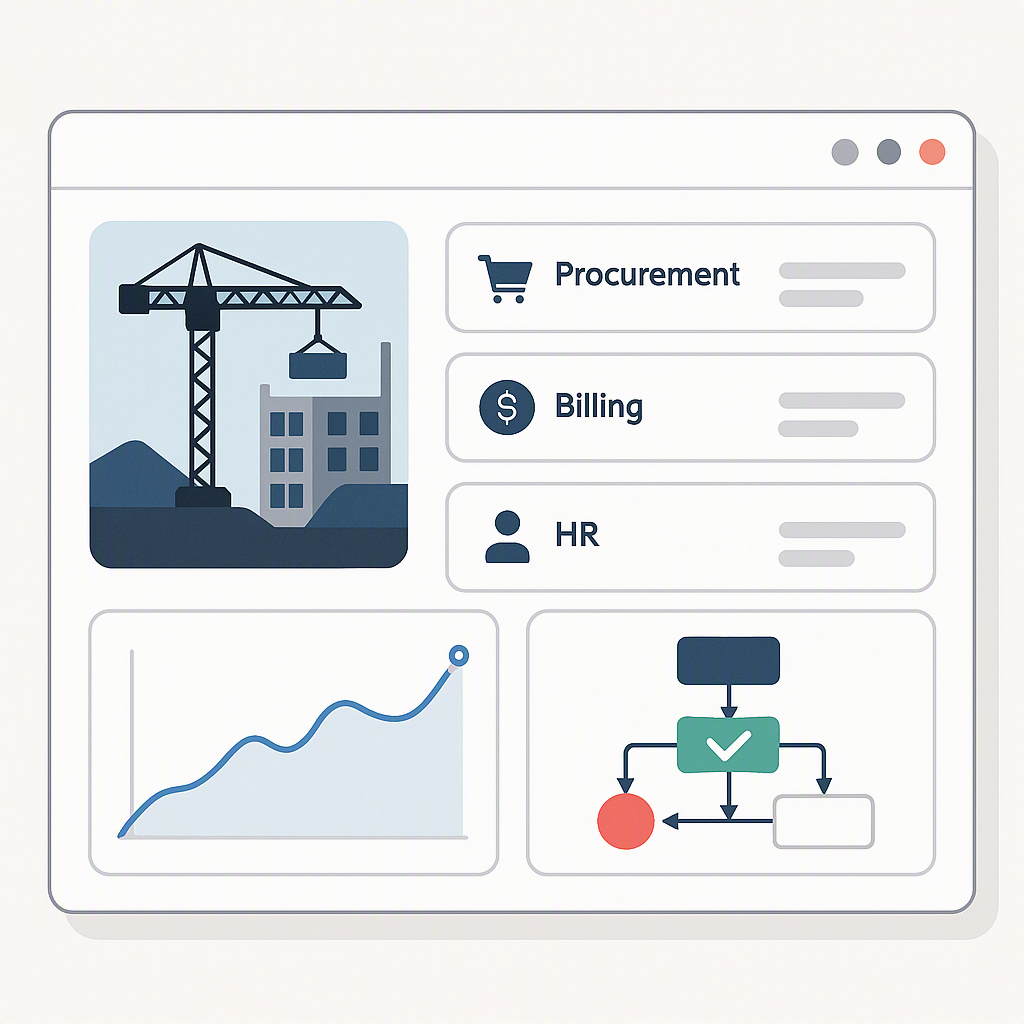
Unified platforms address these challenges by replacing multiple disconnected tools with one integrated system. Tendering, procurement, billing, HR, and finance can all be managed in one place. Every material purchase, subcontractor payment, and equipment hire can be validated against approved budgets, leading to fewer surprises and tighter control over margins.
Illustrative example — Consider a scenario where a contractor uses a unified platform to track project profitability in real-time. Costs are monitored against budgets at various levels, such as BOQ, scope, and estimates. If a line item starts exceeding the budget, the system flags it immediately, allowing the team to take corrective action without waiting for month-end reports.
Prevent Cost Overruns in Construction Procurement dives deeper into this, showing how structured workflows like MR → RFQ → PO reduce errors and protect margins. It’s worth reading if procurement chaos sounds all too familiar.
Why Spreadsheets Don’t Cut It
“But I’ve always used spreadsheets,” you might say. Sure, spreadsheets are versatile. But they’re also prone to human error. Duplicate entries, missed updates, and manual calculations are common pitfalls. Plus, they don’t scale. Managing multiple projects becomes increasingly difficult when your data is spread across numerous files.
Illustrative example — A finance controller might have a BOQ margin report open on one screen and a running spreadsheet on the other. If the spreadsheet contains outdated formulas or missed updates, it could lead to significant discrepancies, resulting in costly errors.
The Compliance Angle
Disconnected systems also complicate compliance. For Indian contractors, GST/TDS calculations, PF/ESI deductions, and statutory reporting are mandatory. Missing a detail can lead to penalties. Enterprise software solutions often automate these processes, integrating with accounting tools and payment platforms to simplify compliance, especially for multi-site operations.
Top Facility Management Software for Contractors in India & GCC explores this further, highlighting how automation simplifies compliance in complex setups.
Learn more at JobNext.ai - Construction ERP